
Feeling overwhelmed by the relentless pace of modern life? You are certainly not alone. As we navigate the complexities of 2026, the demand on our time—from professional deadlines to household management—can often feel like a juggling act with too many balls in the air. The secret to regaining control isn't working harder; it is about working smarter through intentional lifestyle design.
By integrating small, high-leverage habits into your daily routine, you can significantly reduce your mental load and reclaim hours of your personal time every single week. Whether you are aiming to streamline your professional workflow, simplify your home environment, or optimize your personal habits, these smart lifestyle hacks are designed to help you cut through the chaos.
The Core Philosophy of Simple Living
Simplifying your life is not about doing less for the sake of laziness; it is about eliminating the non-essential so you can focus your energy on what truly creates value. When you trade chaos for peace, you create the space necessary for growth, creativity, and deep connection with your loved ones.
The journey toward a simpler life is exactly that—a journey. It is often characterized by two steps forward and one step back, but every tiny adjustment adds up to a massive transformation over time. To start, focus on identifying your top 4-5 priorities and ruthlessly evaluating your current commitments against those goals.
Strategic Workflow Hacks to Master Your Workday
If you find yourself constantly swamped at the office or drowning in a sea of unread emails, it is time to optimize your professional environment. High-performing individuals don't just work longer; they work with greater focus and intentionality.
Implementing the Pomodoro Technique
One of the most effective ways to maintain concentration is the Pomodoro Technique. By breaking your workday into 25-minute intervals of deep, focused work followed by a 5-minute break, you protect your brain from burnout and maintain high levels of output.
- Segment your projects: Use one session for outlining, another for research, and a third for drafting.
- Respect the break: Use those 5 minutes to step away from the screen; this is crucial for long-term cognitive endurance.
Prioritizing with Purpose
Start every morning by identifying the three most crucial tasks you must accomplish before the day ends. Writing these down clarifies your intent and prevents you from getting lost in lower-impact busywork. When you focus on tasks based on their impact on your long-term goals, you naturally filter out the noise.
Automating the Repetitive
In 2026, your time is your most valuable asset. Do not waste it on manual processes that can be handled by software.
- Email Filtering: Set up automated rules to sort incoming messages into folders, ensuring your inbox only shows what is urgent.
- Scheduling Tools: Utilize digital calendar booking links for routine meetings to eliminate the exhausting back-and-forth email chains.
- Workspace Optimization: A clutter-free, ergonomic workspace is not just aesthetic; it is a functional requirement for minimizing distractions and improving focus.
Household Management and Daily Routines
Your home should be a sanctuary, not a source of additional stress. By applying smart lifestyle hacks to your home environment, you can save hours of labor every week and foster a more grounded, intentional lifestyle.
The Power of the Night-Before Prep
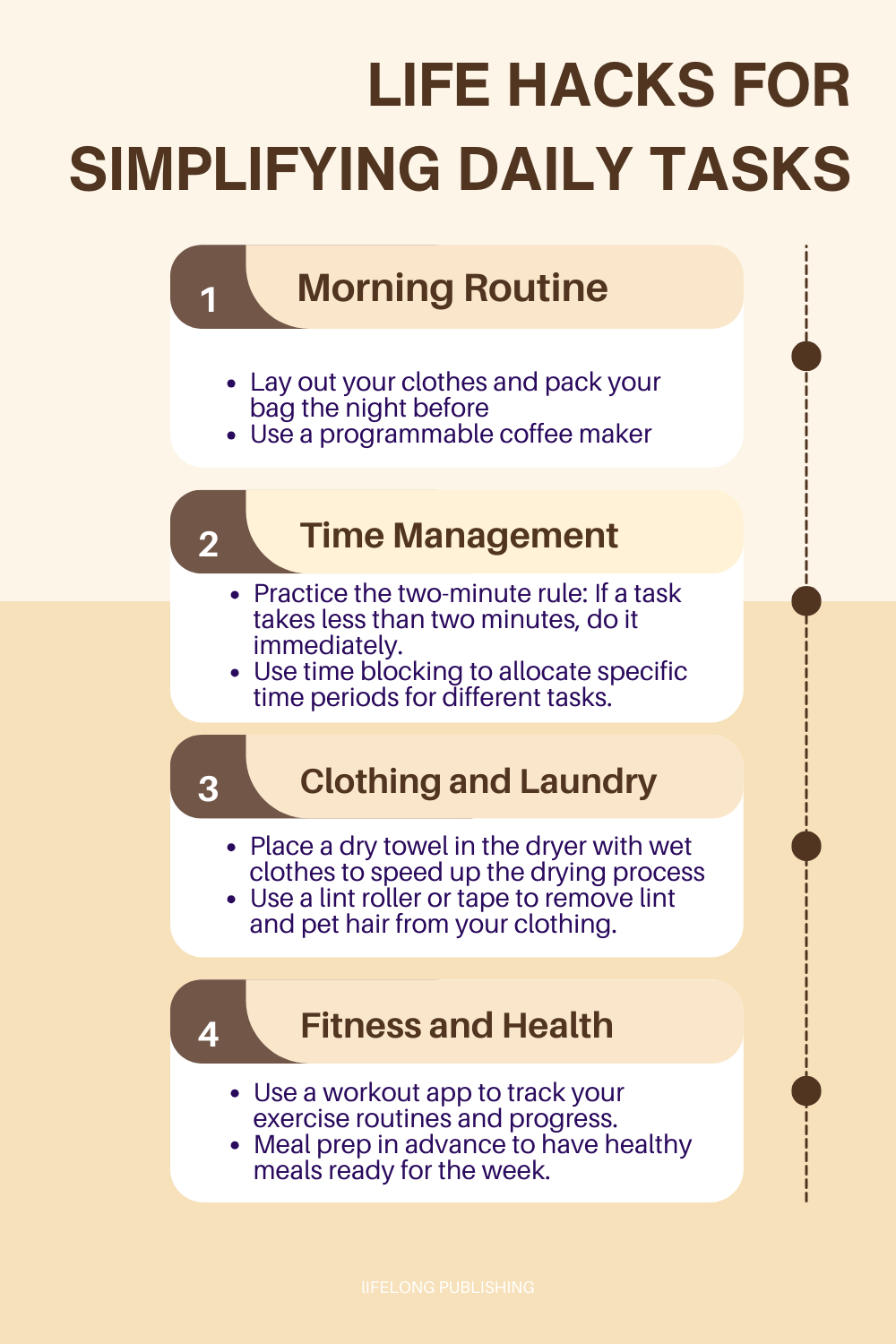
Planning your day the night before is perhaps the most underrated habit for reducing morning friction. By taking just ten minutes to outline your schedule, appointments, and top priorities, you wake up with clarity rather than confusion. This reduces the mental load of starting your day, allowing you to transition into your tasks with momentum.
Keeping Essentials in Designated Spots
Stop wasting precious minutes searching for keys, wallets, or charging cables. When every item has a consistent, designated "home," you eliminate the cognitive drain of searching for lost objects. This simple organizational habit is a cornerstone of an efficient, low-stress environment.
Leveraging Digital Reminders
Don't rely on your memory to juggle your life’s responsibilities. Utilize digital alerts and calendar notifications to offload the mental burden of remembering deadlines, recurring chores, or family commitments. When your phone manages the "when," your brain is free to focus on the "how."
Culinary Efficiency and Kitchen Hacks
The kitchen is often where the most time-consuming daily tasks reside. Whether it is cooking, cleaning, or prep work, there are genius ways to optimize your culinary routine.
The "Upside-Down" Pan Flip
For those who struggle with flipping delicate items like pancakes or grilled cheese sandwiches, there is a simple, physics-based solution. Instead of wrestling with a spatula, hold the food on the spatula, place the frying pan upside-down over the food, and then flip the entire assembly. This ensures a clean, perfect flip every time without the risk of breaking your meal.
Batching and Meal Planning
Meal planning is one of the most effective ways to reduce daily decision fatigue. By dedicating a small window during the weekend to plan your meals, you:
- Cut down on unnecessary grocery store trips.
- Reduce food waste by using what you have.
- Ensure that you are eating intentionally rather than relying on impulsive, unhealthy convenience food.
Embracing Intentionality in 2026
As we look at the landscape of 2026, the trend toward minimalism and simple living is not just a passing fad; it is a necessary response to an increasingly digital and noisy world. Simplifying your life requires the courage to say "no" to things that do not align with your core values.
Remember that you do not need to overhaul your entire life overnight. Small, incremental changes are far more sustainable than radical shifts. Choose one of the hacks mentioned above, master it, and then move on to the next. By curating your habits, you effectively reclaim your most precious resource: time.
Optimizing Your Digital Ecosystem for Mental Clarity
In the modern digital landscape, your phone and computer often act as sources of constant interruption. If you aren't managing your digital environment, it is likely managing you. To simplify your week, you must treat your digital workspace with the same intentionality as your physical office Source 1.
Managing Notification Overload
Notifications are designed to hijack your attention. By shifting from a reactive state to a proactive state, you can eliminate the "ping" anxiety that disrupts your deep work cycles.
- Batch your checks: Instead of responding to every notification immediately, check your communication apps at set intervals throughout the day.
- Silence the noise: Use "Focus" modes to disable non-essential app alerts during your peak productivity hours.
- Curate your feeds: Unsubscribe from newsletters or social media accounts that no longer provide value or contribute to your personal growth Source 2.
Digital Decluttering Techniques
A cluttered digital space leads to a cluttered mind. Over time, we accumulate thousands of screenshots, unused apps, and redundant files that serve only to confuse our navigation.
- The "One-Touch" rule: When you download a file or receive an email, address it immediately—delete it, archive it, or file it into a specific folder.
- App minimalism: If you haven't opened an app in the last three months, delete it. You can always re-download it if the need arises.
- Desktop hygiene: Clear your desktop every Friday afternoon so you can start Monday morning with a clean slate, reducing the visual friction of starting your week Source 3.
Streamlining Personal Finance and Errands
Financial stress and the administrative burden of running a household are significant contributors to daily overwhelm. By automating the mechanical aspects of your life, you free up mental bandwidth for higher-level thinking.
Automating Recurring Payments
There is no reason to manually pay recurring bills in 2026. Set up auto-pay for all fixed expenses, such as utilities, rent, and subscription services.
- Consolidate accounts: Use a single, secure financial tracking app to monitor your spending, which prevents you from having to log into multiple bank portals.
- The "Buffer" strategy: Keep a small, automated transfer going into a high-yield savings account each month, ensuring your emergency fund grows without you having to "find" the money manually Source 2.
Efficient Errand Batching
Running errands piecemeal is a recipe for wasted time and gas. By clustering your tasks, you turn an all-day chore marathon into a single, efficient trip.
- Geographic grouping: Map out your errands based on location. If you need to hit the pharmacy, the post office, and the grocery store, plan a logical route that minimizes driving time.
- The "Waiting Room" list: Keep a running list of errands on your phone. When you find yourself with an unexpected 15-minute gap, check if any of those items can be accomplished immediately.
- Outsource when possible: For recurring items like cleaning supplies or heavy household goods, utilize subscription delivery services to keep your pantry stocked without needing a physical trip to the store Source 4.
Elevating Your Morning Routine for Maximum Momentum
The way you start your morning sets the tone for your entire day. If you begin in a rush, you are playing catch-up until you go to sleep. A simplified morning is built on the foundation of habit stacking.
The "Zero-Decision" Morning
You have a limited amount of willpower each day. Using your morning energy to decide what to wear or what to eat is a waste of a precious resource.
- Curate your wardrobe: Simplify your closet by focusing on high-quality basics that mix and match easily. This eliminates the "nothing to wear" dilemma.
- Pre-set breakfast options: Choose two or three healthy, quick breakfasts and rotate through them. You don't need variety every single morning; you need efficiency.
- The "Launchpad" effect: Keep your essentials—keys, wallet, badge, and bag—in a designated, centralized spot near the door so you can leave without a frantic search Source 1.
Physical Movement and Mental Prime
Physical health is the engine of your productivity. If your body is sluggish, your mind will follow suit. You don't need a two-hour gym session to see results; you need consistency.
- Movement snacking: If you don't have time for a full workout, perform 5-10 minutes of stretching or bodyweight exercises immediately upon waking.
- Hydration first: Keep a full glass of water by your bed. Drinking it before your morning coffee helps rehydrate your system and jumpstarts your metabolism.
- Mindfulness integration: Spend three minutes in silence or journaling. This creates a "buffer zone" between waking up and checking your emails, keeping your nervous system regulated Source 4.
Cultivating Social Boundaries for Personal Peace
One of the most overlooked aspects of a simple life is the management of your social energy. In an era of constant connectivity, learning to say "no" is a superpower.
The Art of the Intentional "No"
You cannot be everything to everyone. When you over-commit, you dilute your ability to perform well in your core priorities.
- Value-based filtering: Before agreeing to a social obligation or a volunteer project, ask yourself: "Does this align with my 4-5 core priorities?" If it doesn't, politely decline.
- The "Not Yet" approach: If you want to help but don't have the capacity, try, "I’d love to support that, but my bandwidth is currently full. Let’s revisit this in a few months."
- Quality over quantity: It is better to have three deep, meaningful interactions a week than to attend six events where you feel exhausted and distracted.
Protecting Your "Deep Work" Time
Just as you protect your work hours, you must protect your personal downtime. If your calendar is a patchwork of commitments, you will never truly recharge.
- Schedule your downtime: Treat your personal time—hobbies, reading, or relaxing—as a non-negotiable appointment. Block it out on your calendar.
- Unplugged zones: Designate specific areas or times in your home where devices are not allowed. This fosters a sense of presence and allows your brain to shift out of "output" mode.
- Communication norms: Let your friends and family know your preferred times for calls or texting. Establishing these norms prevents the expectation of 24/7 availability Source 2.
Optimizing Your Sleep Environment
Sleep is the foundation of all productivity. Without high-quality rest, your cognitive function, emotional regulation, and physical health all decline. Simplifying your sleep routine is an investment in every other area of your life.
The 3-2-1 Sleep Strategy
To improve your sleep quality, implement a simple, time-based protocol that signals to your body that the day is ending.
- 3 hours before bed: Stop eating heavy meals. This prevents digestive stress from interfering with your deep sleep cycles.
- 2 hours before bed: Stop working. Give your brain time to decompress from the complex problem-solving required during the workday.
- 1 hour before bed: Turn off all screens. The blue light emitted by phones and laptops suppresses melatonin, making it harder to fall into a restorative sleep state Source 3.
Creating a Sleep Sanctuary
Your bedroom should be designed for one thing: rest. By removing distractions, you make it easier to drift off quickly.
- Temperature control: Keep your room cool. Studies show that a slightly cooler environment promotes better sleep hygiene.
- Minimalist surfaces: Keep your nightstand clear of clutter. A clear space leads to a clear mind, making it easier to let go of the day's stressors.
- Consistent lighting: Use blackout curtains to ensure your body isn't triggered by early morning light or external street lamps, which can interrupt your sleep cycle prematurely.
Advanced Household Maintenance Hacks
Beyond daily tidying, managing the long-term upkeep of your home can be simplified through systematic approaches. These hacks prevent small issues from becoming major, overwhelming projects.
The "Maintenance Monday" Rotation
Instead of trying to deep clean your entire house on a Saturday, break chores into small, manageable chunks that happen during the week.
- Monday: Laundry and linens.
- Tuesday: Dusting and surfaces.
- Wednesday: Kitchen deep-clean (fridge, oven, pantry).
- Thursday: Bathrooms and floors.
- Friday: Desk and digital decluttering.
- This approach keeps your home in a "ready" state without requiring a weekend-long deep dive that leaves you feeling drained Source 1.
Managing Inventory Like a Pro
Running out of essential items like toilet paper, soap, or pantry staples causes unnecessary stress and last-minute trips.
- The "Par" level: Determine the minimum amount of each essential item you need to have on hand. When you hit that level, add it to your shopping list immediately.
- Visual cues: Use clear containers in your pantry or storage closet. This allows you to see at a glance what is running low, removing the need to dig through cabinets to check stock.
- Bulk for longevity: For non-perishable items you use every month, buying in bulk isn't just a cost-saver; it’s a time-saver that ensures you never have to worry about running out mid-week.
Enhancing Cognitive Performance with Simple Habits
Your brain is a tool that requires specific conditions to perform at its peak. By simplifying your mental environment, you can improve your decision-making and creative output.
Single-Tasking as a Strategy
Multitasking is a myth; it is actually just rapid task-switching, which degrades your performance and increases your error rate.
- The single-focus sprint: Dedicate your full attention to one task until it is completed or until the time block ends.
- Visual cues for focus: If you are in a shared environment, use a signal—like wearing headphones—to indicate that you are in a "deep work" block and should not be interrupted.
- Decision reduction: Reduce the number of decisions you make on minor matters. By automating your routine (e.g., eating the same lunch during the work week), you save your "decision energy" for the work that actually matters Source 4.
Mental Offloading
Your brain is for processing ideas, not for storing them. If you are using mental energy to remember to do things, you are wasting the very resource you need for creativity.
- Capture everything: Use a single, reliable capture tool—a notebook, a notes app, or a voice memo—to record every task, idea, or commitment the moment it occurs to you.
- The "Brain Dump": Every evening, clear your head by writing down every lingering thought or task. Once it is on paper or in a digital list, your brain can stop "holding" it, allowing you to relax more fully.
- Review cycles: Once a week, review your captured tasks and organize them into your calendar or project list. This ensures nothing falls through the cracks while keeping your daily focus sharp.
Mastering the Art of "Micro-Habits"
Big changes often fail because they are too difficult to sustain. The secret to a simpler life is the implementation of micro-habits—tiny actions that take less than two minutes to complete but provide massive compounding benefits.
The Two-Minute Rule
If a task takes less than two minutes, do it immediately. Don't add it to a list, don't postpone it—just finish it.
- Hanging up your coat when you walk in.
- Washing your coffee mug right after you use it.
- Filing an email immediately after reading it.
- These small actions prevent the accumulation of "micro-clutter" that eventually turns into a large, overwhelming mess Source 2.
Anchor Habits for Stability
Anchor your new, simpler habits to existing ones. This is known as "habit stacking" and it is the fastest way to make new behaviors stick.
- The "Brew and Review": While your coffee is brewing, review your calendar for the day.
- The "Brush and Plan": While you are brushing your teeth at night, mentally identify the one thing you are most looking forward to tomorrow.
- The "Commute/Walk and Learn": Use your transit time or daily walk to listen to an educational podcast or audiobook, effectively turning "dead time" into personal development time.
Simplifying Your Personal Development
We often feel pressured to constantly "level up," but true growth happens when you focus on depth rather than breadth. Overloading your schedule with self-improvement goals can lead to burnout.
Focused Learning Paths
Instead of reading five books at once or trying to learn three new skills, focus on one domain for a set period.
- Quarterly themes: Choose one area of your life to optimize each quarter—health, finance, career, or relationships.
- The "One-Book" method: Read one impactful book deeply and implement its lessons, rather than skimming five books and implementing nothing.
- Curated consumption: Be as selective with the information you consume as you are with the food you eat. Unfollow accounts that make you feel inadequate and seek out resources that provide actionable, high-leverage advice Source 3.
Reflective Practice
Simplicity requires awareness. You need to know what is working and what is not.
- Weekly reviews: Spend 20 minutes every Sunday reflecting on the past week. What went well? What caused stress? What can be simplified further?
- The "Joy Audit": Once a month, look at your calendar and your to-do list. Identify the activities that consistently drain your energy and find ways to eliminate, delegate, or automate them.
- Gratitude anchoring: End your day by noting three things that went right. This simple practice shifts your brain's focus from what is lacking to what is abundant, reducing the stress of the "never enough" mindset Source 4.
Building a Supportive Environment
Your environment—both social and physical—either supports your desire for simplicity or fights against it. You must be proactive in shaping the space you inhabit.
Curating Your Physical Space
The objects you own take up mental space. Every item you keep requires cleaning, organizing, and maintaining.
- The surface rule: Keep horizontal surfaces clear. A cluttered kitchen island or desk leads to a cluttered mind.
- One-in, one-out: For every new item you bring into your home, commit to removing one. This naturally caps your belongings and prevents accumulation.
- Quality over quantity: Invest in a few items that you truly love and use every day, rather than many items that you use only occasionally. This makes your daily life feel more intentional and luxurious, even if you own less overall.
Creating "Low-Friction" Zones
Identify the areas of your home where you get the most frustrated and "engineer" them for simplicity.
- The "Morning Path": If you always struggle to get out the door, lay out your clothes, pack your bag, and put your keys in the exact same spot the night before.
- The "Food Prep" zone: Ensure your knives, cutting boards, and spices are grouped together. If you have to walk across the kitchen to get a tool, you are less likely to cook a healthy meal.
- The "Relaxation" corner: Create a space in your home that is strictly for reading or relaxing—no work allowed. When you sit there, your brain will automatically associate that space with rest.
Navigating Social Commitments with Ease
Socializing is essential for well-being, but it can also be a source of stress if your calendar is overfilled with obligations you don't actually enjoy.
Low-Pressure Socializing
You don't need elaborate dinner parties or expensive outings to connect with the people you care about.
- The "Coffee Chat": Invite a friend for a simple coffee or a walk rather than a full meal. It takes less time, costs less, and is often more conducive to deep conversation.
- Host with simplicity: If you do host, focus on the conversation, not the catering. A "potluck" style or simple snacks are perfectly acceptable and often more enjoyable for everyone involved.
- Group connections: Instead of meeting friends one-on-one, organize a group outing. It saves time and allows you to catch up with several people at once, which is a highly efficient way to maintain your social network.
Setting Boundaries with Compassion
People will respect your time if you show that you value it. You can set boundaries without being harsh.
- The "Time-Boxed" visit: If you have to attend a social event, tell the host in advance: "I’d love to come, but I can only stay for an hour." This manages expectations and allows you to prioritize your recovery time.
- Prioritize your "inner circle": You have limited social energy. Spend the majority of it on the people who truly matter—your family and close friends. It’s okay to be less available to peripheral acquaintances.
- Digital kindness: If you can’t make it to an event, a simple, sincere note is enough. You don't need to over-explain. "I'm not able to make it this time, but I hope you have a great event!" is sufficient Source 1.
Managing Daily Information Intake
The volume of information we encounter daily is unprecedented. To remain sane, you must be a gatekeeper of your own mind.
The "Just-in-Time" Learning Approach
Instead of trying to learn everything, learn only what you need to solve the problem in front of you.
- Avoid "Just-in-Case" learning: Don't read a book or take a course just because you think it "might" be useful someday. Only acquire information that you can immediately apply to a project or a goal.
- Consolidate sources: Instead of following twenty news sources, pick two high-quality ones. This gives you enough context to stay informed without the anxiety of the 24-hour news cycle.
- The "Save for Later" trap: Use a tool like a "Read Later" app to save articles you find interesting. If you don't get around to reading them within a week, delete them. If it was truly important, you would have made time for it.
Curating Your Digital "Noise"
Everything you click on influences what you see next. Take control of your algorithm by being intentional about your engagement.
- The "Like" filter: Only engage with content that inspires, teaches, or genuinely makes you happy. Over time, your feeds will reflect your values rather than your fears.
- Turn off recommendations: If possible, use browser extensions that hide the "recommended" sidebars on video or social platforms. This prevents the "rabbit hole" effect where you end up scrolling for hours.
- The "Empty Inbox" goal: Aim for a "Zero Inbox" state by archiving or deleting everything that doesn't require an action. Use folders for reference, but don't let your inbox serve as your to-do list.
Health and Wellness as a Simplification Tool
When you are healthy, everything feels easier. When you are unwell or exhausted, even simple tasks feel monumental. Prioritizing your physical vitality is the ultimate hack for simplifying your week.
The "Standardized" Diet
You don't need to be a gourmet chef to be healthy. By standardizing your meals, you reduce the decision fatigue that leads to poor food choices.
- The "Base + Topping" strategy: Keep a stock of base foods (grains, proteins, greens) and vary the toppings or spices. It’s easy to prepare, healthy, and requires very little brainpower.
- Hydration as a habit: Keep a water bottle with you at all times. Often, what we perceive as hunger or fatigue is actually mild dehydration.
- Prep in the moment: If you don't have time for a full weekend meal prep session, wash and chop your vegetables as soon as you get home from the store. It makes cooking during the week much faster and less of a chore.
Movement as a Recovery Tool
Exercise shouldn't be another chore on your list. Use it as a way to decompress and reset your nervous system.
- The 10-minute walk: A short walk outside, especially in the middle of the day, is more effective at reducing stress than a long, high-intensity workout that leaves you feeling more depleted.
- Low-impact integration: Choose activities you actually enjoy—dancing, gardening, or walking your dog—rather than forcing yourself to do a workout you dread.
- Listen to your body: If you are exhausted, choose a restorative activity like yoga or deep breathing over a strenuous workout. True simplicity is knowing when to push and when to rest.
Reflecting on Your "Why"
Simplification is not a destination; it is a way of living. Every time you feel the pull toward complexity, return to your core priorities.
Re-evaluating Your Priorities
As you grow, your priorities will change. Regularly checking in with yourself ensures your lifestyle still aligns with who you want to be.
- The "Quarterly Review": Once every three months, take an hour to review your life. Are you spending your time on the things that actually matter to you? If not, what can you change?
- The "Value Alignment" test: When you feel overwhelmed, look at your calendar. How many of the things you've committed to align with your top three values? If the number is low, it’s time to start saying "no."
- Celebrate the progress: Don't focus on how far you have to go; celebrate the small steps you've already taken. Simplification is a cumulative process, and every small win builds the momentum you need for a more peaceful, focused, and rewarding life.
References
-
Jonathanmpham — Daily Life Hacks: 55 Tips for Every Area | Jonathan M. Pham, 2026
-
Plantoorganize — 24 Ways to Simplify Your Life and Create a More Organized, Stress-Free …, 2026
-
Swipit — 67+ Genius Life Hacks You’ll Wish You Knew Sooner – Swipit, 2026
-
Lifehack — 77 Ideas to Simplify Your Life and Feel Better Today – Lifehack, 2026
-
Anoffgridlife — 34 Clever Hacks to Embrace Simple Living and Get Back to Basics, 2026
-
Makingsenseofcents — 15 Easy Ways To Simplify and Improve Your Daily Routine, 2026
-
Thesquaremagazine — Quick And Easy Lifestyle Hacks That Can Make Your Life Easy!, 2026
-
Plantoorganize — 20 Practical Ways to Simplify Your Life and Reduce Daily Stress, 2026